


.svg?logo=github)

.svg)
.svg)
.svg)
⚠️ Work in Progress: This library is still under construction and contains bugs and missing features. Use in production environments is not recommended.
Pangolin (or pgl) is a header-only C++ library for computational geometry in the plane. It is designed to be pleasant to use, exact when needed, and easy to combine with standard C++ containers and algorithms. A python binding called pypgl is also available.
#include <iostream>
int main() {
std::cout << s << " intersects " << t << std::endl;
return 0;
}
Convenience umbrella header for the PGL library.
Two-dimensional point with optional label payload.
Definition point.hpp:129
Unoriented closed segment between two endpoints plus optional segment label.
Definition segment.hpp:58
constexpr bool intersects(const OtherPoint &other) const
Tests whether this shape and the other shape intersect (A ∩ B ≠ ∅).
Definition intersects.hpp:48
There are many more illustrated examples that give a good overview of the library's features and syntax.
Shapes and Predicates
| Family | Shapes |
| 0-dimensional | Point, EmptyShape |
| 1-dimensional | Segment, OrientedSegment, Line, OrientedLine, Ray, MonotoneChain, Polyline |
| 2-dimensional | Halfplane, Triangle, Rectangle, Disk, Convex, Polygon, PolygonWithHoles, PolygonSet, HalfplaneIntersection |
| Polymorphism | Shape |
The following predicates are implemented as methods of all shapes.
- contains(Shape) Does it contain the other shape?
- boundaryContains(Shape) Does its boundary contain the other shape?
- interiorContains(Shape) Does it contain the other shape in the interior?
- intersects(Shape) Do the two shapes intersect?
- interiorsIntersect(Shape) Do the interiors of the two shapes intersect?
- separates(Shape) Does one shape cut the other into two (or more) components?
- crosses(Shape) Do both shapes separate each other?
if (d.contains(o))
std::cout << "Disk contains " << o << std::endl;
if (d.contains(diam))
std::cout << "Disk contains the diameter" << std::endl;
if (!d.interiorContains(diam))
std::cout << "Disk's interior does not contain the diameter" << std::endl;
Closed Euclidean disk stored by boundary points plus optional disk label.
Definition disk.hpp:66
constexpr Segment diameter() const
Returns a segment defining the diameter.
Definition measures.hpp:73
Exact Constructions
Predicates among integer coordinates are implemented with exact integer arithmetic. When a construction requires non-integer coordinates, it will return exact rational types of arbitrary precision by default.
std::cout << "The midpoint of " << s << " is " << midpoint << std::endl;
Point< ERational > EPoint
Definition pgl.hpp:98
constexpr Point< ResultNumber > midpoint() const
Returns the midpoint of the segment.
Definition measures.hpp:79
It is possible to choose rational types with fewer digits manually:
Exact rational number class template.
Definition rational.hpp:106
Notice that sometimes it is possible to obtain integral results with scaling:
std::cout << "The midpoint of " << 2*s << " is " << midpoint2 << std::endl;
If performance is not critical, you may use arbitrary precision rational numbers everywhere with ERational, EPoint, ESegment, etc. If performance is important, the library allows you to fine-tune number types accordingly. See types.md for more information.
Other Methods
Several other methods are supported by the shapes.
std::cout << "The diameter of " << c;
std::cout << " is defined by " << s;
std::cout <<
" and has length " << s.
length() << std::endl;
Closed convex polygon stored by its vertices.
Definition convex.hpp:170
constexpr Segment< PointType > diameter() const
Returns a segment realizing the diameter (the farthest vertex pair).
Definition measures.hpp:696
ApproximateNumber length() const
Returns the Euclidean length.
Definition measures.hpp:50
Visualization
A Canvas class is provided for visualization. It includes support to export to svg, pdf, and ipe files.
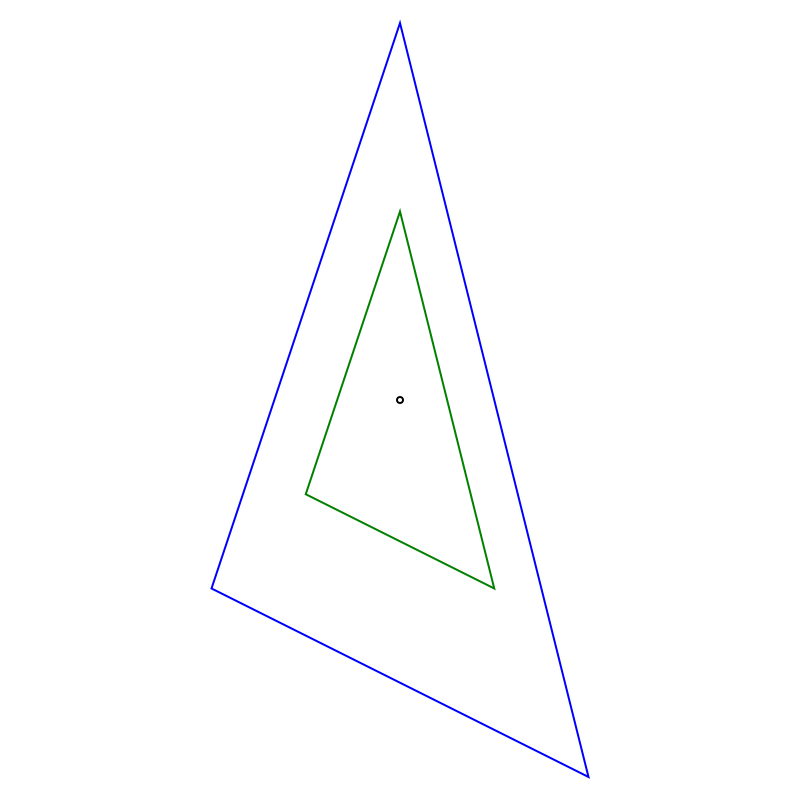
Stores drawable objects and exports them as an SVG image.
Definition canvas.hpp:128
void writeIPE(const std::string &path) const
Serializes the canvas to an Ipe XML file (.ipe).
Definition canvas.hpp:361
void writePDF(const std::string &path) const
Serializes the canvas to a PDF file.
Definition canvas.hpp:282
void writeSVG(const std::string &path) const
Serializes the canvas to an SVG file.
Definition canvas.hpp:236
@ stroke
Definition canvas.hpp:36
Closed triangle stored by three vertices.
Definition triangle.hpp:53
Comparison and Hashing
All geometry types are comparable and hashable, so they can be stored in standard containers:
std::set<decltype(s)> set;
set.insert(s);
std::unordered_set<decltype(s)> uset;
uset.insert(s);
Algorithms and Data Structures
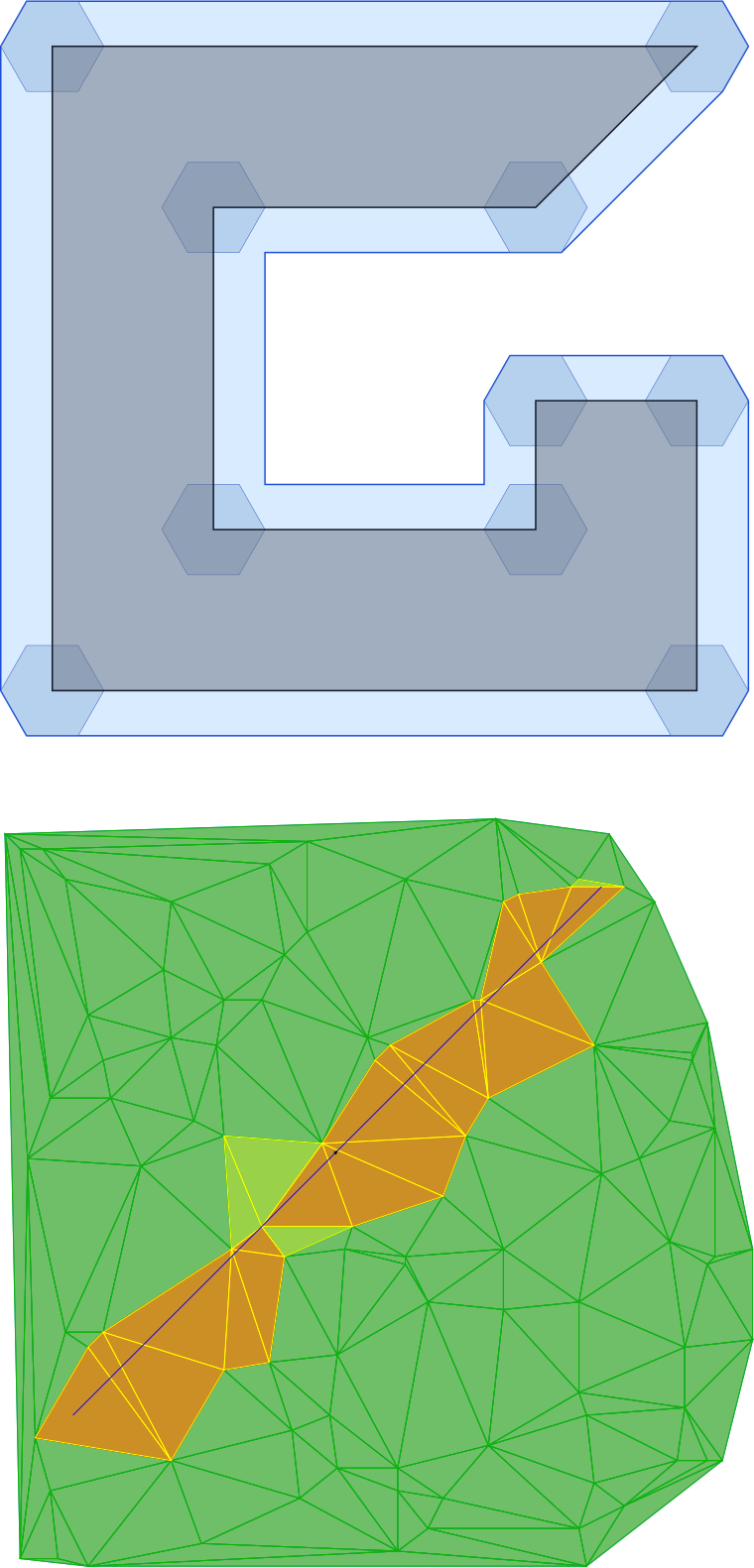
Pangolin includes fundamental algorithms:
Comparison to CGAL
There are several architectural differences between Pangolin and CGAL, we summarize some of them:
| Feature | Pangolin | CGAL |
| Dependency-free | ✓ | ✗ |
| Learning | Easy | Hard |
| Architecture | Monolithic | Modular |
| Geometry | Plane only | 2d, 3d, hyperbolic... |
| Maturity | Very low | High |
| Number types | Per-shape | Per-kernel |
| Type conversion | Implicit | Explicit |
| Shapes | Mostly non-oriented | Oriented |
| License | MIT | LGPL, GPL, and commercial |
- Pangolin defines the shapes as their geometric concepts, instead of their computational representation. For example, a Triangle is the same regardless of the order of its 3 vertices (in contrast to CGAL's oriented triangles).
- Pangolin stores lines and halfplanes as 2 points (instead of an equation), so rational numbers are not needed to exactly represent a line passing through any two integer points. Notice that the comparison operators (and hash function) take care of testing if two lines are equal even if they are defined by different points. Similarly, disks are represented by 3 boundary points.
- Pangolin implicitly converts shapes that use different number types, so it is easy to use rational numbers or larger numbers only when needed.
- Pangolin does not distinguish between points, vectors, and directions.
- Pangolin predicates return true or false, instead of some CGAL predicates that return 3 possible values for inside, outside, and on the boundary. Boundaries and interiors are distinguished by different predicates such as contains, boundaryContains, and interiorContains.
- Even simple queries often require composing several CGAL primitives. For example, checking whether a segment lies inside a polygon has no direct predicate, and CGAL::intersection has no overload for a segment against a polygon: you must combine endpoint side-tests with per-edge intersection checks, or build a 2D arrangement. In Pangolin these are polygon.contains(segment) and polygon.intersection(segment).
- It is hard to compare the performance against CGAL, as many algorithms are not available in one or the other. Overall CGAL has faster more complex implementations. For example, pgl's decomposition-based Minkowski sum is much slower than CGAL's convolution-based Minkowski sum and a little slower than CGAL's decomposition-based Minkowski sum. Surprisingly, pgl's trapezoidal map point location is significantly faster than CGAL's in our benchmarks.
Build
As a header-only library with no dependency, you can clone the repository and then compile code directly with g++ or clang++:
g++ -std=c++23 -Iinclude/ -o example examples/example1.cpp
clang++ -std=c++23 -Iinclude/ -o example examples/example1.cpp
If you want cmake to automatically download the library, you can include this snippet in your CMakeLists.txt:
include(FetchContent)
FetchContent_Declare(
pgl
GIT_REPOSITORY https://github.com/gfonsecabr/pgl
GIT_TAG main
)
FetchContent_MakeAvailable(pgl)
target_include_directories(your_target PRIVATE ${pgl_SOURCE_DIR}/include)
Acknowledgments
Pangolin is developed by Guilherme D. da Fonseca, with many contributions from the undergraduate student Djebril El Feddi.
The library itself is dependency-free, but a few third-party components are bundled to support testing, benchmarking, and PDF export. We are grateful to their authors:
- doctest by Viktor Kirilov — the unit-testing framework (MIT).
- PDFGen by Andre Renaud — a trimmed port powers the Canvas PDF export (public domain / The Unlicense).
- plf_nanotimer by Matt Bentley — timing in the benchmark suite (zlib-style license).
- Many AI have been used to write the code, including Claude, ChatGPT, and GitHub Copilot.
More Information

 1.17.0